Posts from the “Little House” Category

Roof! And a newspaper feature

Posted on February 9, 2016

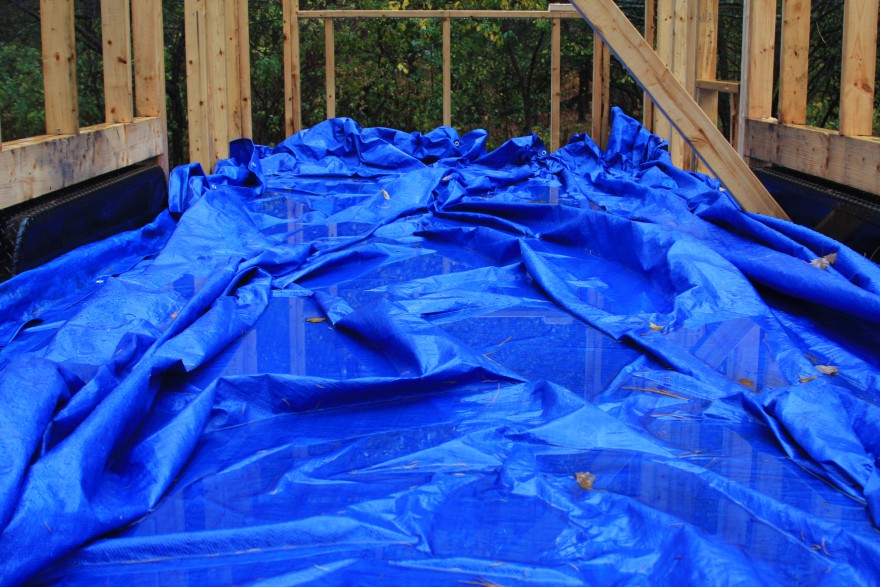
Welcome, readers of the MetroWest Daily News! We’re delighted you’ve stopped by to check out our little project. Please read on for one of our progress updates.  If you’re not from the MetroWest Daily News, click here to read the article and watch the video featuring our tiny house! Thanks to Seth’s hard work over the last week or so, the roof deck of the tiny house is in place just in time for this week’s rotten weather. We’re still keeping the tarp over the everything to protect the plywood from moisture as much as possible, but we’re in decent shape for snow.  Unfortunately, we managed to not take any pictures of the house with the entire roof on, so you’ll have to believe us…

The return of the light

Posted on December 22, 2015

Happy winter solstice! I can think of no better way to celebrate the light’s return than at a farm.  We spent our solstice morning helping out with a  friend’s grain threshing day.  This 5-acre farm grew rice, wheat, and dried beans this season, and hosted a party for those of us who wanted to try our hands at hulling, grinding, and processing the grains to make them ready for human consumption. There were old exercise bikes mounted to older milling implements, an 1851 wheat chaff separator, a fire barrel, and some tinkering and ingenuity as we kept breaking down and starting up again.

We drove to the tiny house after lunch to close it up for this week’s rain. Just before the light left for the day, we burnt some herbs and our intentions for the year 2016, and then rounded out the evening at home in our pjs eating an all local dinner.

Sometimes, friends, we just get it right.  And we’re wishing you a good winter season full of things you get right too.  Happy solstice.


Boxing it in

Posted on December 7, 2015

High-res version

December is being kind to us, starting with a couple weeks of mild weather and letting us find our feet with the plywood sheathing for the tiny house.  Find our feet because Seth’s winter schedule is different from his summer schedule, so we don’t have a build day together that often.  Once every two weeks or so?  Three?  I couldn’t say.

When we are together (and migraine-free), we hang plywood.  It took two sheets for us to get a good process down with just two of us, but now we’re a little more than halfway done with the wall sheathing thanks to some time and generosity from friends.

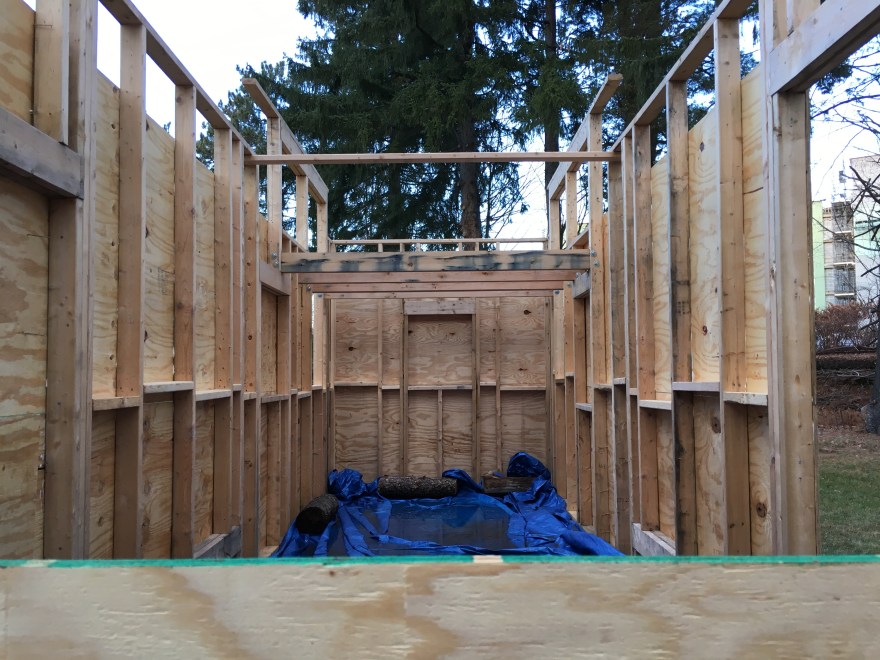
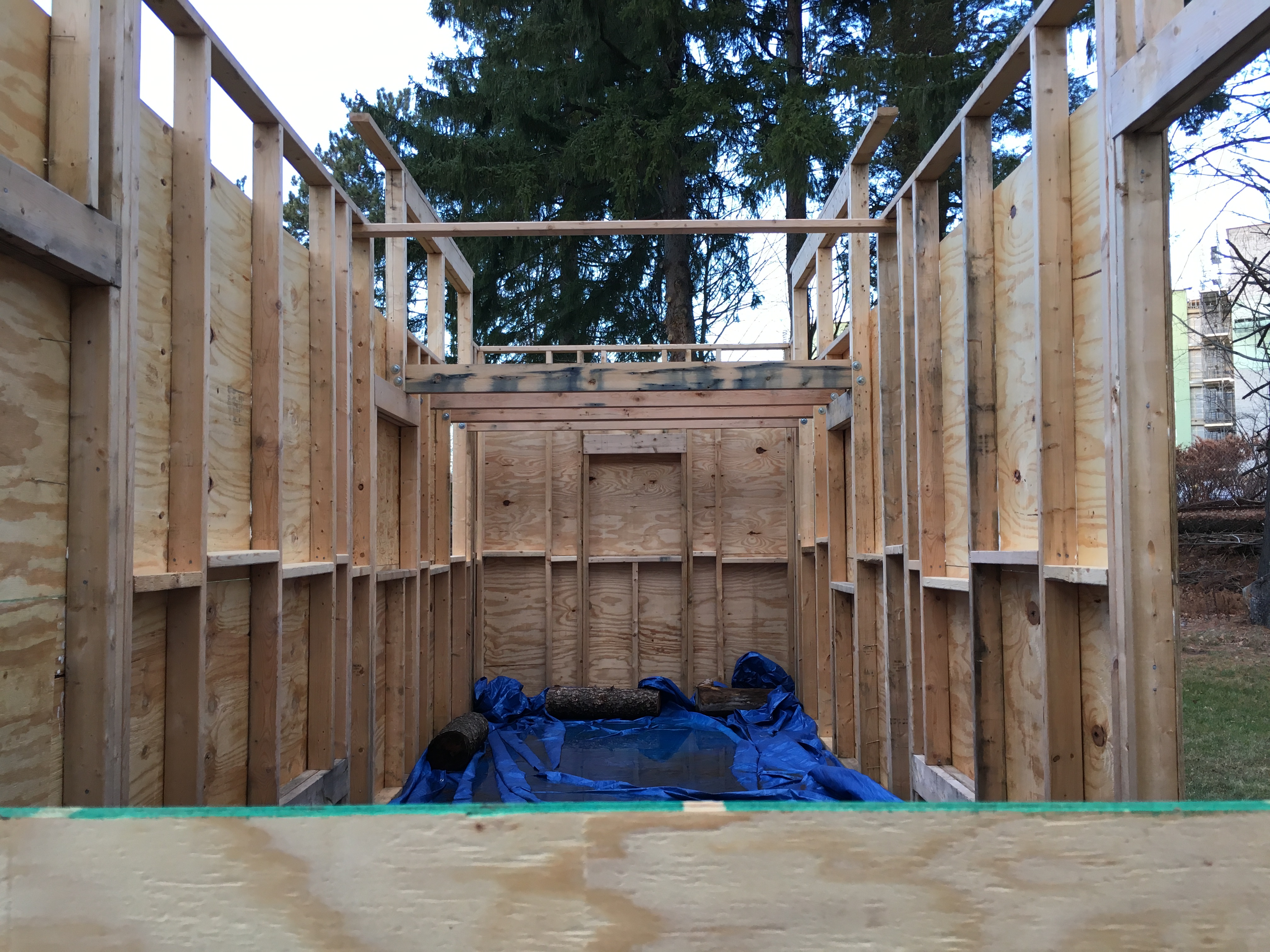
I spent the afternoon yesterday making a template for the plywood to go over the wheel wells, and then cutting the plywood and hanging it.  And let me tell you something: plywood is heavy!  A day later and I’m still tired.  But the house looks nice, don’t you think? We are inching ever closer to getting things boxed in so we can put the roof rafters on.

We chose to sheathe the walls of the house first so that the plywood will sit up fully under the roof rafters.  The alternative was putting up the roof rafters first and then trying to fit the plywood underneath where the rafters hit the walls.  Both methods are valid but from what I understand, the way we’re doing it is easier.  Then again, I feel a little like Anne of Green Gables when she says, “Have you ever noticed one encouraging thing about me? I never make the same mistake twice.”

And then Marilla says, “I don’t know as that’s much benefit when you’re always making new ones.”

Time will tell if we’re making a mistake.  But the good news is that once we know about it, we won’t make it twice.

Wind, water, and weather

Posted on November 13, 2015

High-res version
IMG_0987

House progress has been slow going for the last month as we straightened out the beam situation. But we were both looking forward to the week’s vacation I took from work this week so we could get some serious house building done. Unfortunately, it turns out that Hurricane Kate, while not landing on the East Coast, made for for several wet, drizzly days in a row in the middle of my vacation that made it less than ideal for running power tools. And coupled with another migraine, meant that half of my vacation was down the tubes.

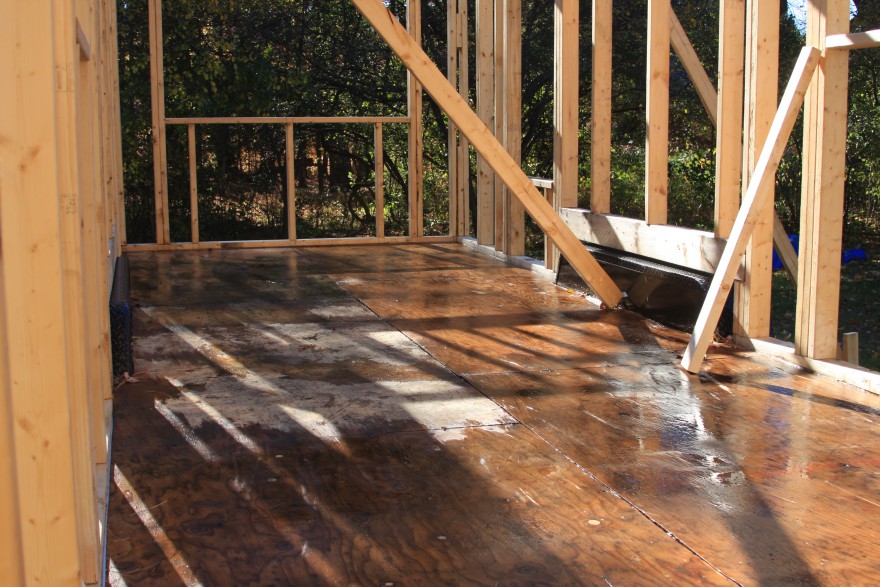
It’s not really a catastrophe, or even very bad.  It made for a leisurely vacation.  We put up those beams, did some planning, some planing, and other things. The frustrating part comes from the thought of our house getting soaked again. Argh!  Water.  And although it’s nice out now with these 50 degree days, winter is coming on soon.  We’re going to have to hustle to get the house closed up in time for snowfall.  Otherwise we could be looking at all kinds of water damage, like soaked plywood floors, wood that bows up and out, damaged beams.  You know.

IMG_0965IMG_0967

No worse than usual, I guess!

A home made by hand

Posted on November 10, 2015

Craigslist has been a good friend to us.  We’ve spent hours poking around the different Craigslist sites for the region.  First it was lumber, then plywood, then cabinetry, windows, and finally beams.  Sometimes it was a stroll through the Materials tab to see what was available, just in general.  And the more we see on Craigslist, the more our hearts grow with the thought of making this home, all of this home, by hand.

I don’t know what it is.  No, scratch that.  I know what it is.  It’s the feeling of accomplishment, and of being able to point to something and say, “I know exactly where that comes from.  I know how long it took to make.  I remember researching how to install it, and I remember putting in the nails.  Here’s the finish we used.”  Seth has been leading this charge, I think because of his work as a CSA farmer, which is the ultimate in showing where something came from and how it grew.  And so when it came time to put in the first wood in the house that would be visible (vs. being enclosed by walls), it was only natural that we said to each other, “Wouldn’t it be great if we used old, reclaimed wood from some historic house somewhere?”

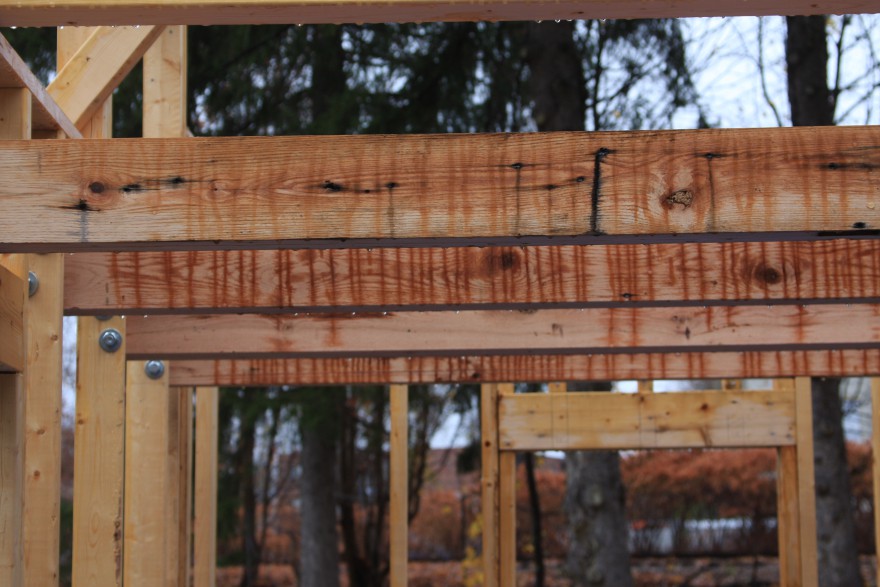
The wood I’m talking about is for the exposed 4″ x 6″ beams that support our kitchen loft.  Craigslist showed us half a dozen entries with old, reclaimed beams.  Some were from modern houses going for a new look, some were from old, old houses being torn down, and some were somewhere in between.  We lucked out and read about a 1792 house in Rhode Island that the owner decided to deconstruct.  His listing described American Chestnut beams.

Hold the phones!  American Chestnut used to be one of the most common trees on this side of the Mississippi.  That is, before it was decimated by blight brought over with chestnut trees from Japan in the early 1900s.  There are no living stands of American Chestnut.  The wood is almost impossible to find.  Which means, of course, that we had to have it.  And so one crisp evening after a full day of farming, Seth drove a borrowed truck down to Rhode Island and loaded up seven axe-hewn beams.

It took us four weeks to schedule the beam pickup, remove the nails from the beams, attempt to saw them on our own table saw (and fail), and finally break down and hire a portable sawmill to re-saw the beams into manageable sizes in our own driveway.  When I described this process to some of my contractor friends at work, they said, “You know, 4″ x 6″ beams are really cheap at Home Depot.  You should just buy those and slap some stain on them.”

I could have responded with the long answer, but I think I shrugged and said, “Aesthetics, you know?” And they nodded.   But the long answer is this: We want to be able to say we made every bit of this home with materials we want, going for the look we want, and hang the time frame.  It’s important for us to know each part of this house, know it in the way that painters know each brush stroke and dancers know each muscle.  We’re not building just a house; we’re building our home.

The raising of the walls

Posted on September 21, 2015

This slideshow requires JavaScript.

With the weather on our side this weekend, we got our walls in the air.  It was the first of what I hope will be many community build days, and a big thank you to Zach, Richard, Linda, Jules, Jay, Evie, Andrew, and Alex! This crew was amazing.

Over the last several weeks, Seth and I have spent our weekends measuring and cutting wood, and then laying out walls and nailing them together.  But for the day of the wall raising, we still needed to build half of each of the long walls. And so Seth and I began this past Sunday with frantic wood cutting.  A little more than an hour in, Linda arrived and took over the measuring portion, and I began to lay out walls.

Then as everyone else arrived, we divided into two crews.  A few of us finished laying out the two wall halves on the ground, and everyone else lifted our already built walls into place. We moved along at a good clip.  It turned out to be a repetitive process: lay down sill seal; lift wall into place; adjust so that it’s level, flush with the trailer, and plumb.; nail down bottom plate; brace wall with a long 2×4; nail in corner posts; repeat. Before we broke for a late lunch, we nailed together the two half walls.  And by we, I mean Seth, Zach, and Julie, who were pretty badass with the way they handled the nail guns.

By the end of the day, everyone could still account for their eyes and fingers, and Seth and I left our skeleton of a house standing where there used to be nothing but a trailer.  I call that a success! We’ve still got a ways to go, but it’s exciting getting our walls up and showing people just how spacious a tiny house can be on the inside.  Here’s to one step further on this adventure.

Insulation and Lumber

Posted on August 16, 2015

With the trailer finally ready to go, we placed an order for wood and insulation. “Wait!” I can hear Seth saying, “it wasn’t that easy.”  Of course it wasn’t!  Because when you’re Christine, you have to research everything about everything, all of the time.  What can I say?  It’s what I do. For insulation, we needed 2.5″ of rigid foam to fill the space within the trailer. Rigid foam is lightweight, it cuts easily, and the kind we picked doesn’t absorb water.  This is important because we want to discourage mold growth as much as possible, thanks to my health sensitivities. We chose to go with 1″ of xps insulation, and 1.5″ of polyiso insulation.  In the best of all possible worlds, this will…

Leveling the trailer

Posted on August 16, 2015

Every tiny house trailer is unique. Even Tumbleweed trailers, though they’re “standardized,” have their own quirks trailer by trailer.  It’s just the way it goes when you custom fabricate large obects.  Each weld is different, each component of each axle, the way the lights are attached, they shape of the tongue.  If you’re thinking about purchasing a tiny house trailer, accept this now: Your trailer will not be perfect. New or old, you will have to account for something wonky. This is something we didn’t recognize, so when we began leveling the trailer, we were frustrated, despite the fact that the steps to leveling a trailer are actually pretty simple. Purchase trailer leveling jacks.  We bought 6 of these jacks, and used them all.…

Flashing Repairs

Posted on August 16, 2015

We took a weekend away from working on the house in July to meet up with some friends for vacation, and over the weekend it rained. This is not a vacation recap! It was nice seeing our people, but the point of this post is the tiny house. When we came back to the trailer, we realized part of the flashing had torn away. You see, the rain over the weekend collected in the tarp over the trailer. The water in the tarp weighed down on the flashing, putting too much pressure on the screw points. And since the flashing is only thin pieces of aluminum, it couldn’t withstand the weight and pulled loose along one section. The aluminum was beyond repair and had…

Flashing: Finis

Posted on July 15, 2015

Because we bought a trailer that is just a frame with wheels, we had to perform some alterations to ready the foundation of our house before we can build on it.  Namely, we had to install flashing on the underside of the trailer.  The flashing protects the insulation, which we will be laying directly into the trailer frame, as well as the sub-floor, which will go over it.  Flashing makes the house road-worthy.  No sense in making a beautiful house if the floor is going to rot out from under your feet. In addition to installing flashing, we added a 2×4 “nailer” to each side of the trailer.  See, our trailer’s width extensions are not made of thick enough metal to support a piece…