Flashing Repairs

Posted on August 16, 2015

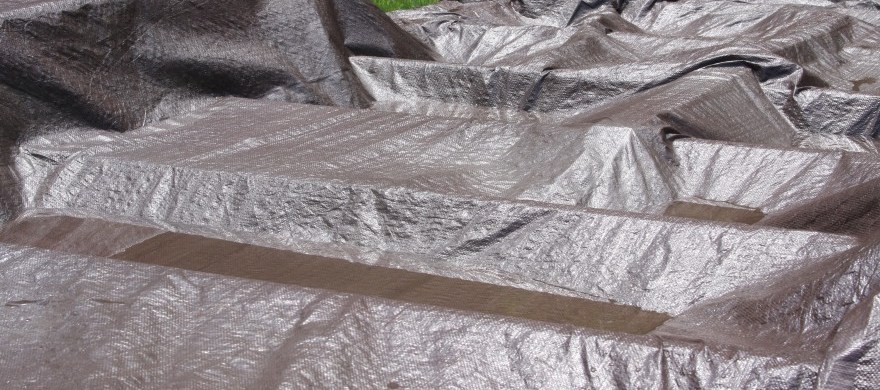
We took a weekend away from working on the house in July to meet up with some friends for vacation, and over the weekend it rained. This is not a vacation recap! It was nice seeing our people, but the point of this post is the tiny house. When we came back to the trailer, we realized part of the flashing had torn away.

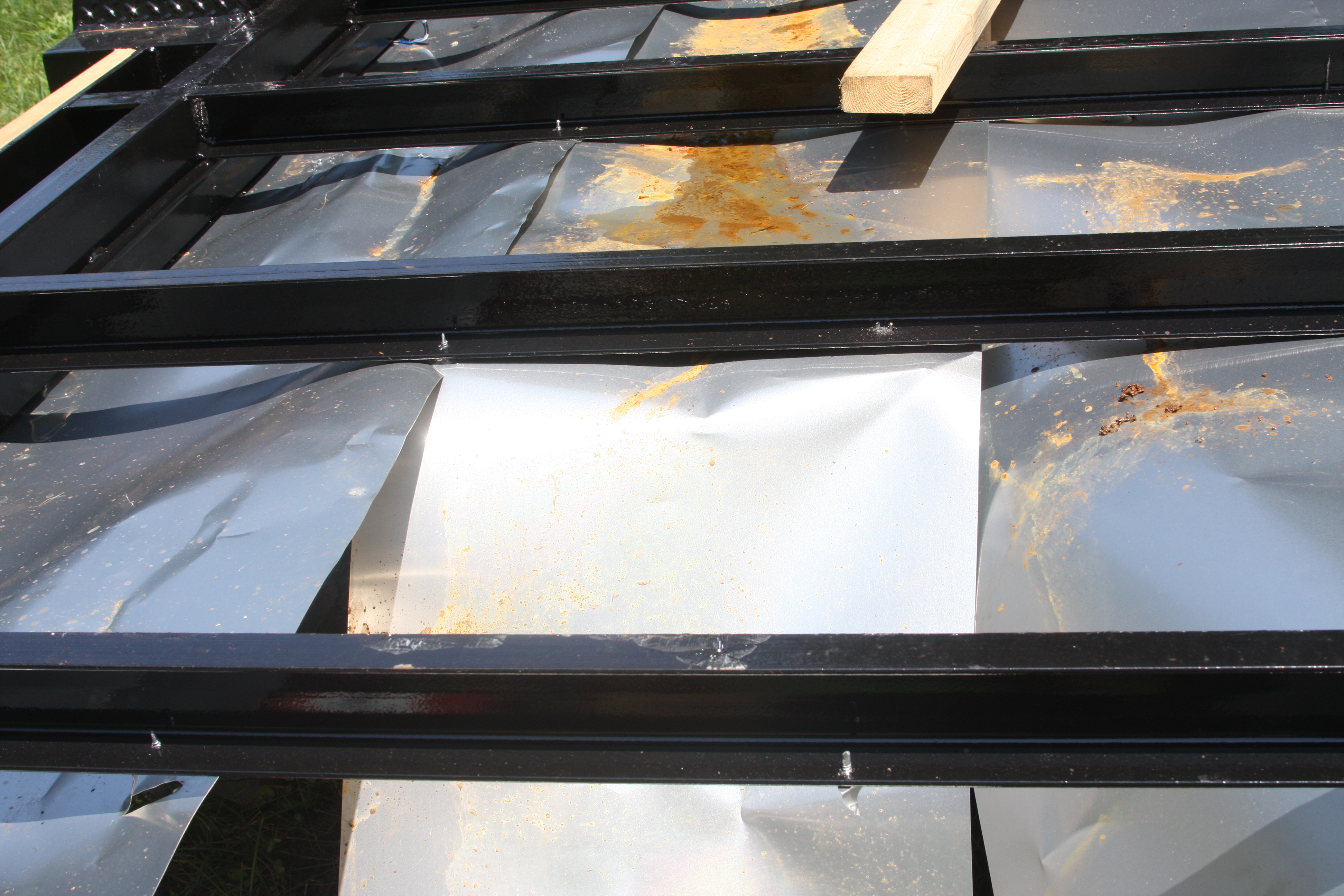
You see, the rain over the weekend collected in the tarp over the trailer. The water in the tarp weighed down on the flashing, putting too much pressure on the screw points. And since the flashing is only thin pieces of aluminum, it couldn’t withstand the weight and pulled loose along one section. The aluminum was beyond repair and had to be replaced. If we had left the tarp off the trailer for the weekend, the water would have been able to leak out of the gaps in the flashing (which is the purpose of the gaps, by the way). We wouldn’t have had to replace the flashing on our return, only dried it off a little bit and dealt with some rust spots.  Hindsight is 20/20.

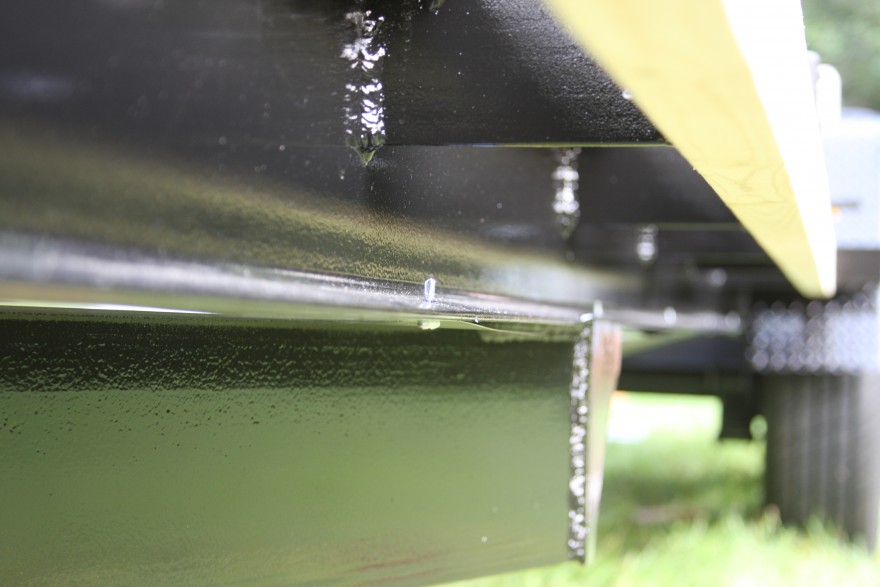
IMG_0807Thankfully, the picture looks a lot worse than the actual damage.  When all was said and done, a 4 foot piece of flashing had to be cut away and replaced, taking a little more than an hour to fix.

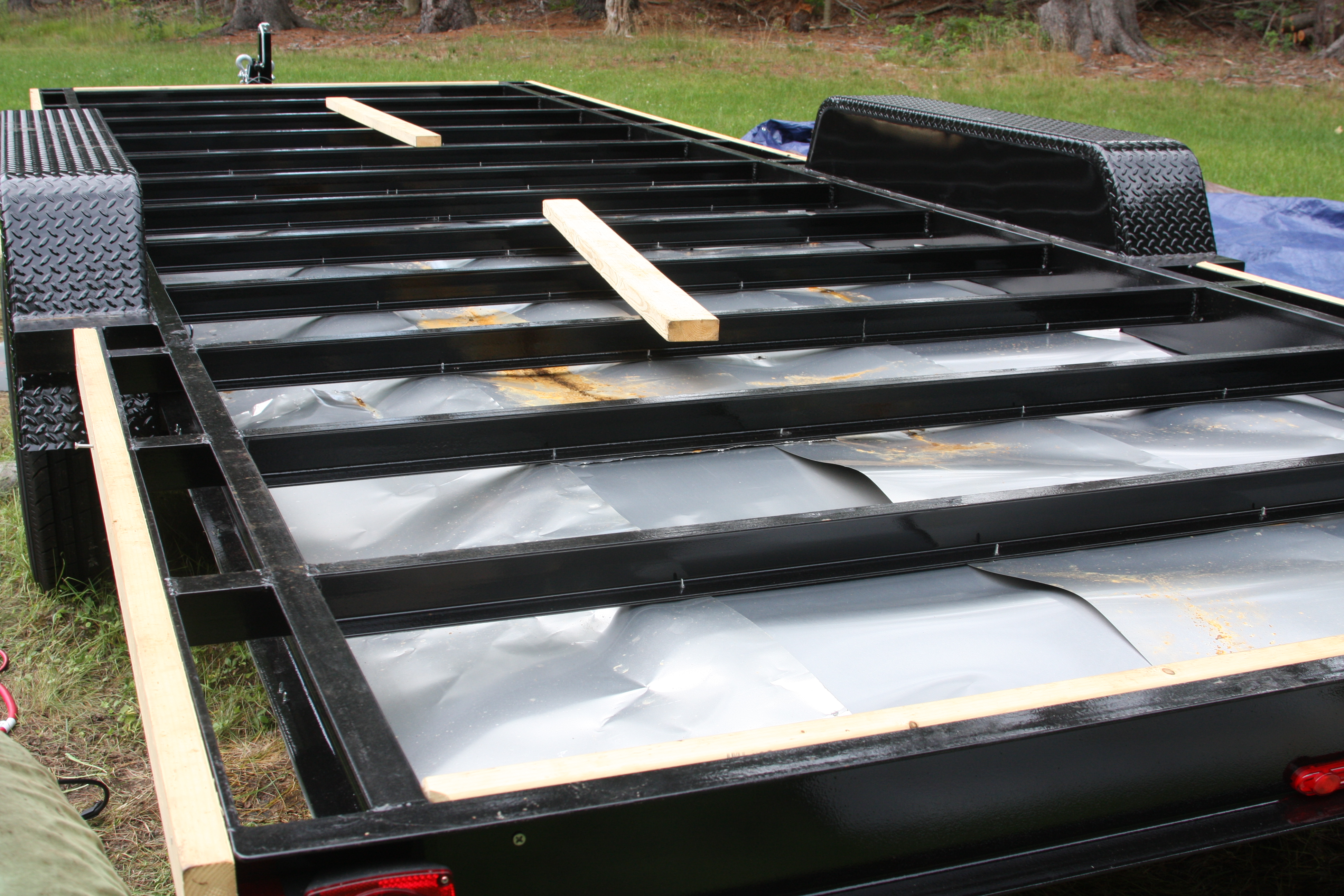
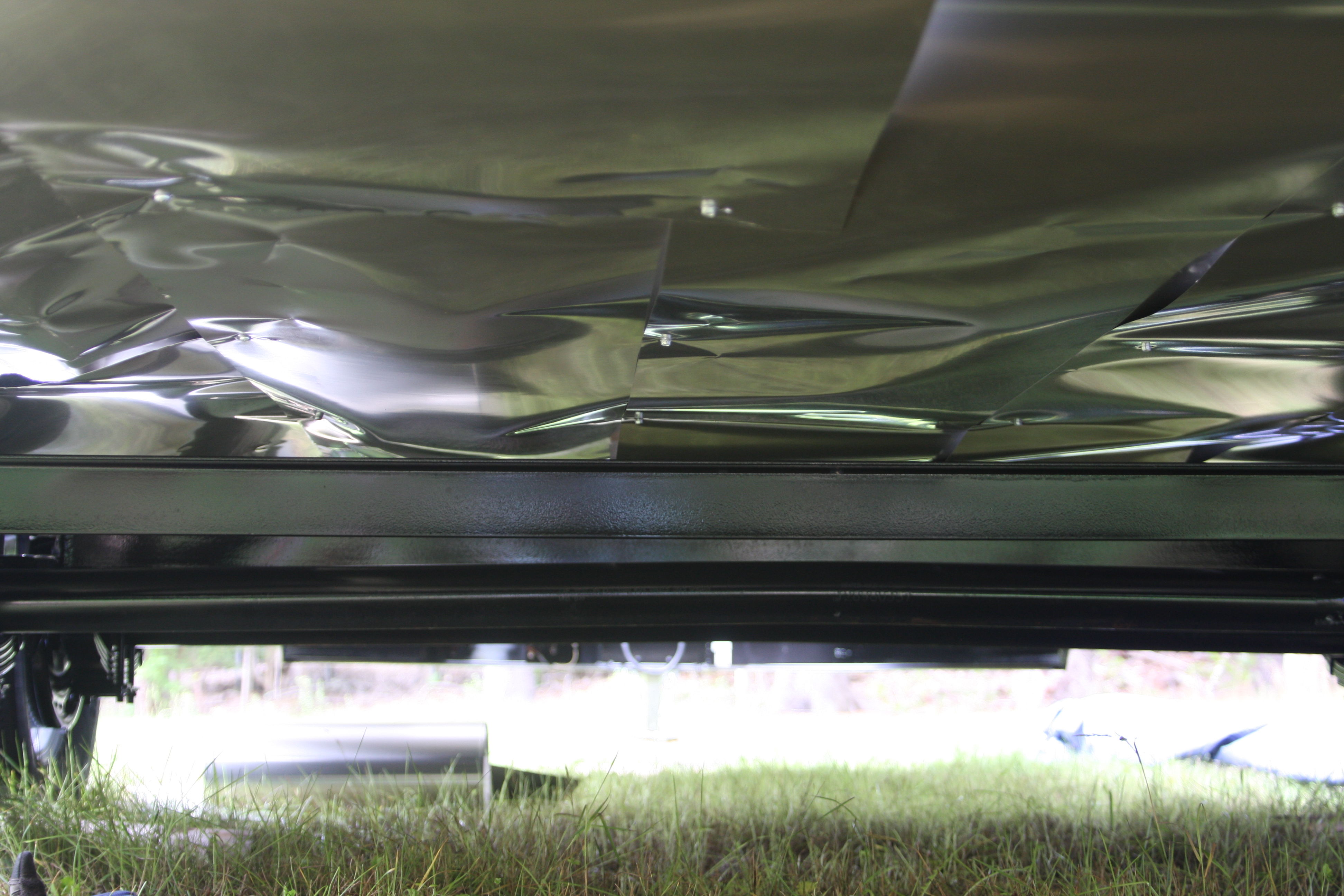
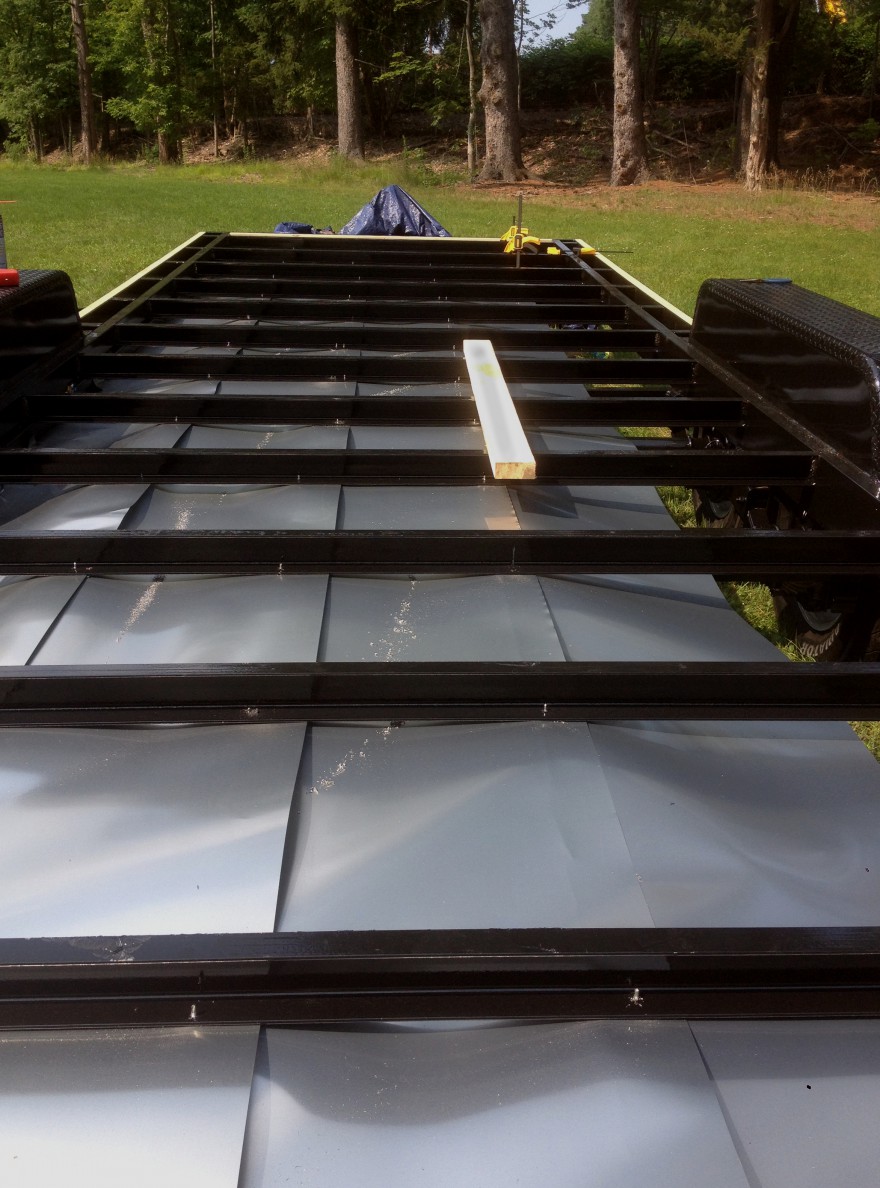
IMG_0810 IMG_0812Once we made the repair, we decided to be more cautious with the flashing.  You can see that it sort of fish-mouths in places. It gapes, leaving openings where water can get in from splash-back as we drive. The reason it does this is because it’s difficult to pull the aluminum roll taut across the 24 foot length of the trailer, despite our efforts with friends and grip clamps.  Other tiny house builders make installing flashing look easy, but since Seth and I have the sneaking suspicion that we live in a sitcom, it came out lumpy for us. Of course it’s lumpy! It couldn’t be anything else.

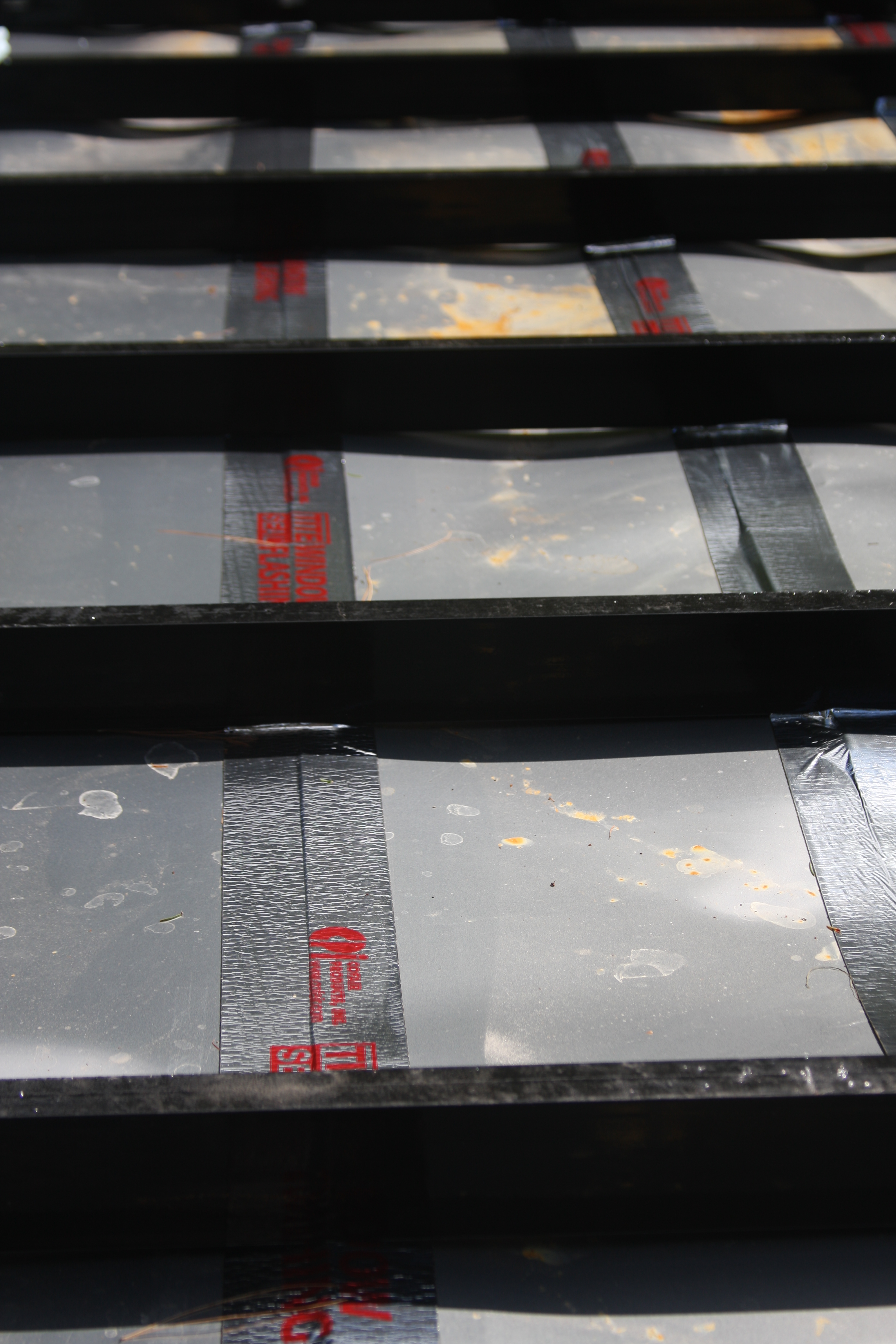
There’s a fix for this as well.  Before laying the subfloor insulation into the trailer, we decided to tape the majority of the seams up with flashing tape.

IMG_0879Flashing tape can be found in the roofing section of a home improvement store. It’s weatherproof tape that goes around a window or a door frame when you’re building.  One side is shiny so that if you tape something up and then leave it exposed to the weather before getting around to putting on the siding, you won’t ruin the weatherproofing of the tape.  Fancy, eh?

We taped up the seams between the cross beams of the trailer, leaving gaps where the water can still run out if it happens to collect, but making it much less likely for water to migrate in once we’re moving.  This was another fairly quick process, taking about two hours total.  Onwards and upwards!  Next comes the subfloor.

Flashing: Finis

Posted on July 15, 2015

IMG_2599Because we bought a trailer that is just a frame with wheels, we had to perform some alterations to ready the foundation of our house before we can build on it.  Namely, we had to install flashing on the underside of the trailer.  The flashing protects the insulation, which we will be laying directly into the trailer frame, as well as the sub-floor, which will go over it.  Flashing makes the house road-worthy.  No sense in making a beautiful house if the floor is going to rot out from under your feet.

In addition to installing flashing, we added a 2×4 “nailer” to each side of the trailer.  See, our trailer’s width extensions are not made of thick enough metal to support a piece of dimensional lumber — at least not comfortably.  We also needed a way to attach the walls to the trailer along the outside edge.  The nailer fits the bill for both jobs.

Seth did most of the nailer and flashing work over several days.  I think our trailer steel is made out of adamantium, because it takes a large amount of arm strength, patience, and screws from a place that is not Home Depot to drill through the trailer.

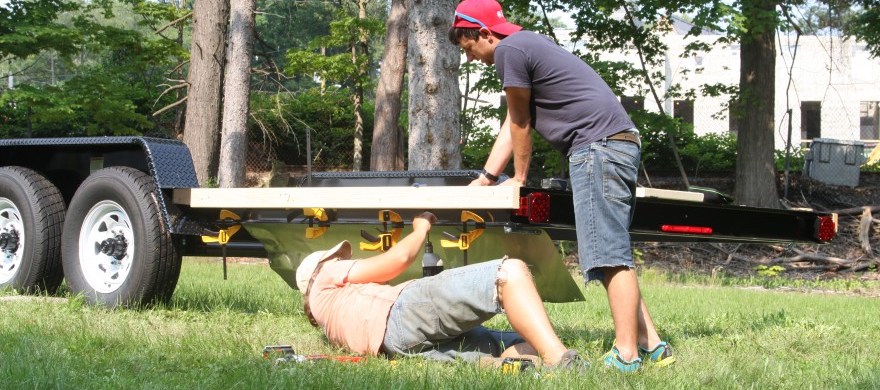
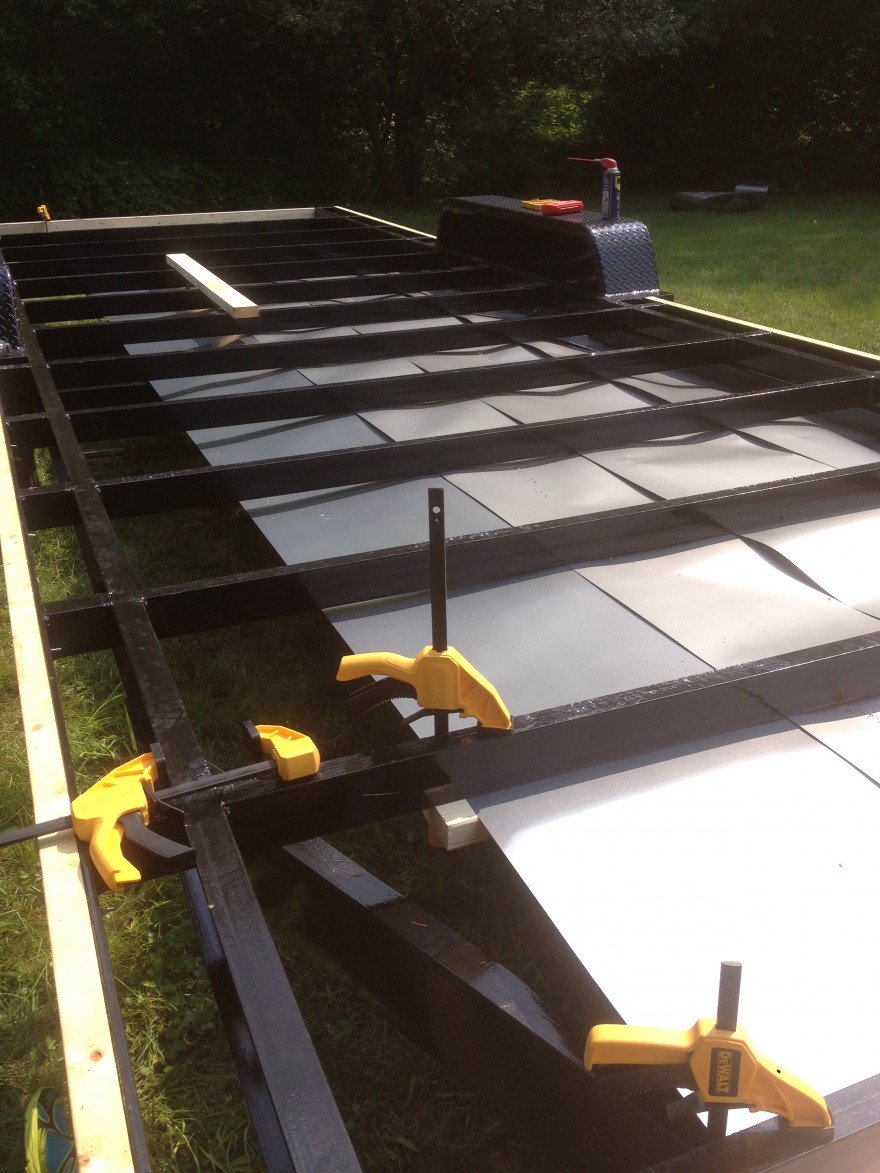
After a while we got into a rhythm.  First we positioned the flashing on the underside of the trailer, overlapping the next piece of flashing by about 3″, and held it in place with quick grip clamps.

IMG_0630 IMG_2598

Then someone would get under the trailer and drill a pilot hole through the trailer cross members while another person holds things tight.

IMG_0647

Then finally, we used a hardened steel, self-tapping screw to attach the flashing.  (Don’t buy your screws from a big box store, they will snap when they engage with the metal.  Ask me how I know.)

IMG_0641

We used aluminum roof flashing, purchased in 20″ x 50′ rolls.  In theory, overlapping the seams by 3″ will allow any water that finds its way in to migrate out.  If I’ve learned anything from my job, it’s that water will always find a way in no matter how well you seal everything, so you might as well give the water an exit path.  But even as I say that, we’re thinking about taping up some of the seams to make it less likely that road grime will make it into our subfloor while we travel.

A couple of notes: first, drilling through a trailer is hot, hard work.  Have some oil on hand to lubricate the drill bit as you’re drilling a pilot hole and your drill bit will last longer.  Also, wear protective eye gear and maybe long sleeves while you’re drilling because those metal filings are hot when they drop on you.  And that being said, keep your mouth shut while drilling.

Put something between your flashing and your trailer because dissimilar metals that are touching each other will corrode over time. We’re hopeful that our trailer paint will do a decent job at protecting the aluminum flashing from the steel trailer, but we’ll have to keep an eye out to see what’s going on down there, especially as we travel and water works its way into everything.

And finally, we consulted Andrew and Gabriella Morrison’s Tiny House Build DVDs for advice on how to complete this project.  Super helpful and thorough!

Shout-out to our friends Andrew and Justin, who were integral for this project.  Working on the house is nice, but working on the house with friends is a party.  A tame party.  Where everyone is tired at the end.

Earth-friendly agriculture: Stearns Farm

Posted on July 7, 2015

Greenhouse tomatoes, with lettuces beyond

Greenhouse tomatoes, with lettuces beyond

Meadow sage flowers in the remembrance garden

Meadow sage flowers in the remembrance garden

As part of our continuing quest to prep ourselves for the farm in our future, Seth and I will be visiting farms that use sustainable practices and writing profiles of the farms and farmers. In a lot of cases that will mean organic farming, but there are other methods out there like crop rotation, no-till planting, companion planting, and more that we’re dying to learn. Good thing farm folk are friendly! I’ve never met a farmer who wasn’t willing to share as much information as we wanted.

Our first stop on this Earth-friendly agriculture journey is with Stearns Farm in Framingham, Massachusetts, which is the farm where Seth works as an Assistant Grower.

When Seth first began hunting for a farm job, he looked specifically at organic farms so he could learn the basics of growing food without synthetic pesticides and fertilizers.  No surprise there, with our history.  Thankfully, Seth found Stearns, an organic vegetable farm that grows on four acres.

Stearns is a little different from most farms in the area.  For starters, they grow vegetables without USDA organic certification. Other farms are either certified organic or use pesticides, but Stearns opts out of that dichotomy. The reason that Stearns — and many small farms — didn’t get organic certification is because it costs a lot of of money and time, and on a small farm those resources are needed elsewhere. However, the farmers at Stearns are committed to environment health so they use organic practices, and they welcome all of their their clients to the farm to see for themselves how the crops are grown. This is one reason why it’s good to know your farmer! You know where your food is coming from.

One perfect strawberry
One perfect strawberry

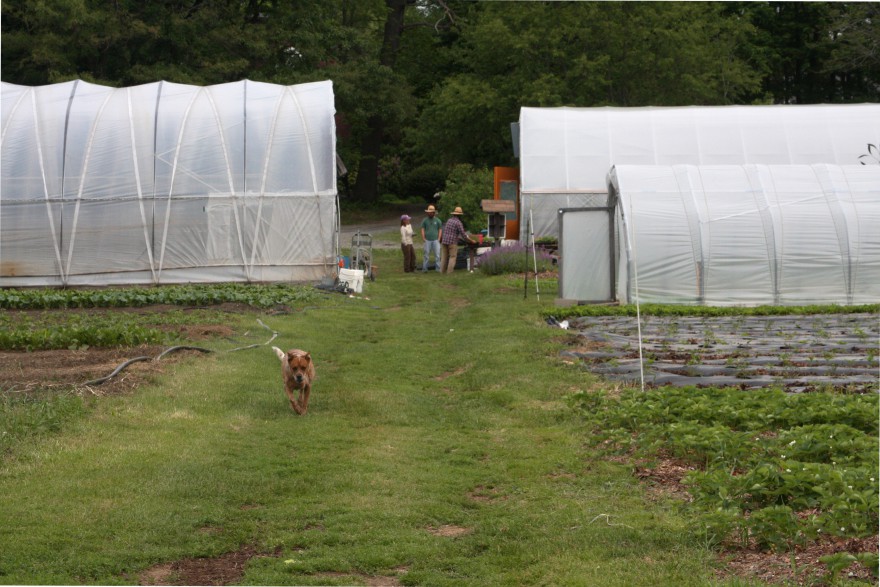
Looking down the main path toward the greenhouses

Looking down the main path toward the greenhouses

Stearns was incorporated in 1994 as a nonprofit organization, but prior to that it had been worked as farmland since 1723, and possibly earlier! Stearns is a community-supported agriculture (CSA) farm, which means that anyone who wants vegetables buys in at the start of the season, and then picks up their vegetables every week once harvests start. And here’s what else makes Stearns unique: People who buy shares are asked to work 12 hours in the field throughout the course of the season, as well as picking certain labor-intensive crops like berries or beans on share pickup days. Stearns is one of the only farms in the area where you do farmwork for your vegetables, and it’s a huge draw. People love to come to the farm and spend time planting seedlings or harvesting squash, or any myriad of tasks that come with farming. It’s a good way to connect with your food.
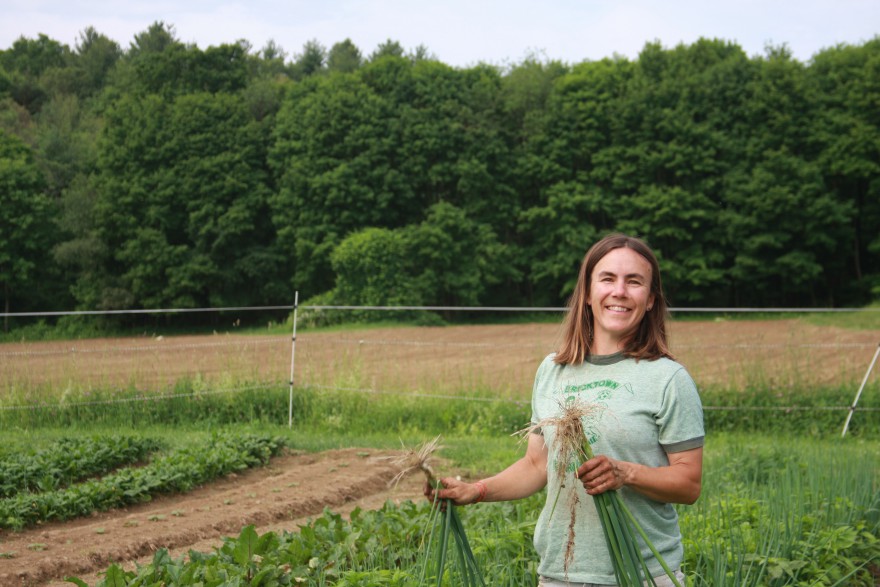
Susan Peters, Farm Manager

Susan Peters, Farm Manager

Stearns grows vegetables and fruit under the tutelage of Farm Manager Susan Peters. Susan is in her third year with Stearns, and previously began farming in Vermont in 2005. She knows just about everything I want to know about farming, and she’s got a wicked sense of humor to boot. I love hanging out with her on the farm (and by “hanging out,” I mean, “weeding together while picking her brain”). She always seems to have a sense of the weather, what needs to get in the ground, and how many people-hours it will take. Susan is a large part of why Stearns is successful. She connects with the CSA sharers so naturally, I’m amazed that this isn’t her own land and she hasn’t been doing this all her life.

I asked Susan once why she switched from being a librarian to being a farmer. Susan grinned at me and said, “Because I realized I didn’t want to spend any more time indoors.” Amen, sister.

The third staff member of the Stearns farming team is Kenneth Hacker, the Assistant Farm Manager. Kenneth has an infectious love of all things food and farming, and is very busy this season. I only see him at lunchtime when I’m there. He waves to me as he rides by on the tractor though, so we’re good.

And of course, Lily the dog serves as the official greeter of farm guests.  She also patrols the fields for pests like rabbits and groundhogs, and acts as a general deterrent for deer and birds. We’re able to send Lily to the farm with Seth every day because Lily takes care to walk in between the rows and poop in the woods instead of in the fields.

Looking out over greens to the field tomates

Looking out over greens to the field tomatoes
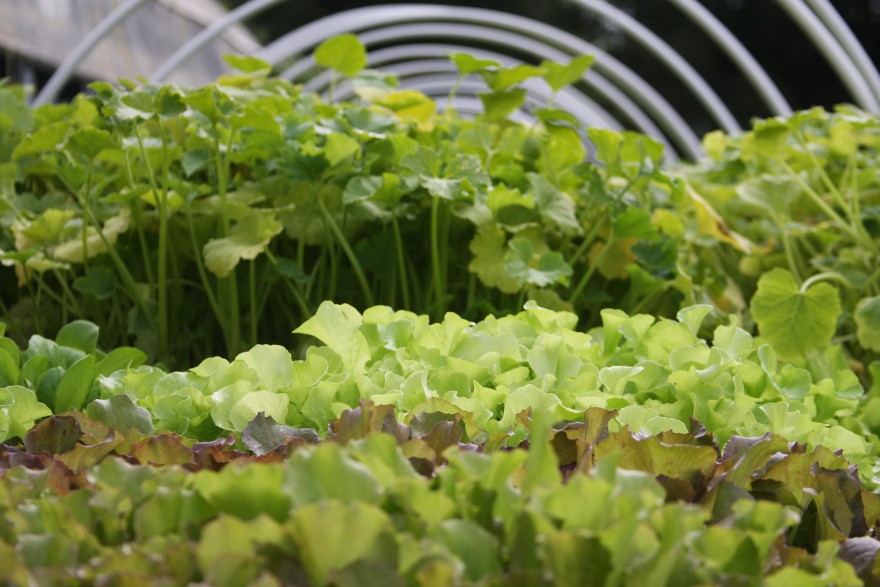
Lettuce and cilantro seedlings

Lettuce and cilantro seedlings

Susan, Kenneth, and Seth know that farming is a balance.  You need good soil, and you need good people.  On a piece of land that has been farmed as long as Stearns, it’s important to maintain fertility for the long haul. The farmers use cover cropping in the winter, which means planting a crop of rye grass, hairy vetch, or winter peas in late fall, and then turning that crop back into the soil in the spring. This serves a twofold purpose. It prevents snow and rain from washing away the rich topsoil, and also fixes nutrients back into the soil. Besides that, the farmers soak every seedling in a fish fertilizer emulsion before planting. Fish fertilizer is fermented ground fish mixed with water, and it gives the seedlings a huge boost. And finally, the farmers lay down drip irrigation every year, which prevents soil runoff by delivering water only where it’s needed.

The other half of farming at Stearns is good people.  Over the past two years, Seth and I have come to realize that Stearns Farm is a booming CSA because they cultivate community along every step of the way. They train their CSA sharers to look beyond imperfections, to take part in the process of growing foodstuffs, and to think even a tiny bit more like a farmer.  It’s not just picking up your vegetables and running out again like at a grocery store, it’s participating in how the food gets to your plate.  It’s appreciating that your lettuce was alive and growing that morning, or getting dirt under your fingernails.  It’s people who care a great deal about what they’re growing for you. And that kind of enthusiasm is contagious.

Tiny house design

Posted on June 17, 2015

Screen Shot 2015-06-17 at 1.20.28 PMScreen Shot 2015-06-17 at 1.17.29 PMScreen Shot 2015-06-17 at 1.18.38 PM

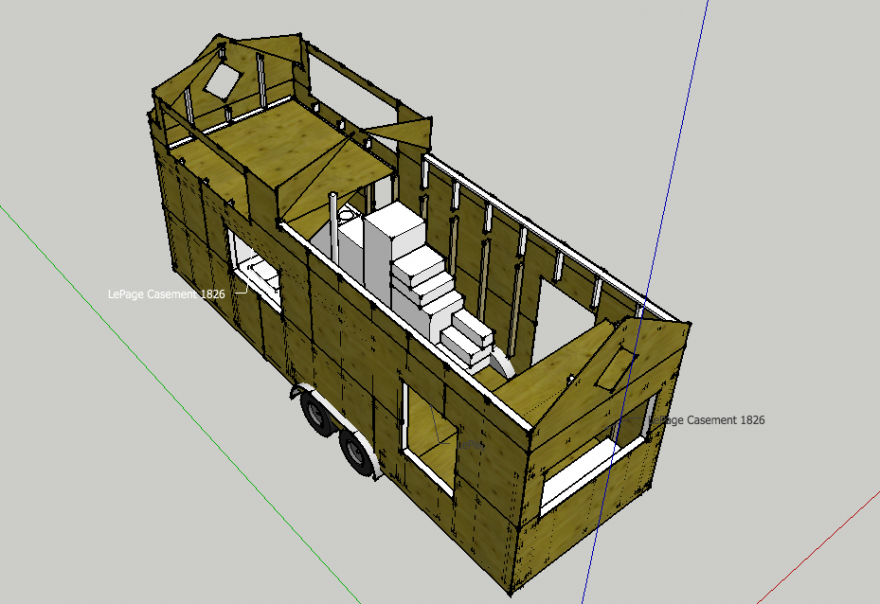
Ta da!  Presenting the Earth Morning tiny house design.

If you’ve spent any time looking at tiny houses on wheels, you know they are all fairly similar in design because of the size constraints of the trailer.  Our tiny house has the same size constraints, but we’ve spent some time personalizing the inside.  As you can see, we’re inspired by the Tumbleweed lofted bed design, with distinctions: Our bathroom will be located across the tongue end of the trailer; we’ll have a large kitchen with counters spanning two sides of the house; and we’ll have a stairway instead of a ladder so Lily can access the sleeping loft.

Our vital stats:

Exterior footprint: 8’x24’, not including trailer tongue

Interior dimensions: 7’4”x23’

Loft height: 3’11”

Cathedral ceiling height: 10’8″

Kitchen ceiling height: 6’4″

Bathroom size: 3’x7’4”

We created our house plan in Google Sketchup.  There are a lot of pre-made tiny house plans that we looked at and could have purchased, but when we were doing research, the more we looked the more we realized that nothing quite fit us and our lifestyle.  And tiny houses are so small, it was hard to argue with the idea of designing one ourselves.

Although the sketchup plan doesn’t look “finished,” it’s finished for now because we want to be able to play with the framing after we source our windows and doors.  This is an important step!  We’ll be looking at surplus materials in a lot of instances instead of ordering custom or off-the-shelf items. Keeping the finished materials off the design gives us the flexibility to change our wall studs without adjusting other parts of the design.

We threw some unfinished furniture onto the floor of the tiny house to get a sense of scale and also to see the best layout for our stairs and other items.  Let me tell you — having this design is a relief.  We’ve been able to “build” the house and know where each piece of wood is going to fall, before getting started.  We headed off some wonky spots.  And we have something to show off.  It’s the start of something big.  Tiny big!

Choosing a trailer

Posted on June 7, 2015

Seth and I sent in a deposit for our trailer just after receiving the go from Grace Church, thereby guaranteeing that we will have a trailer by late June. We waited until we had a build site locked down before ordering because we wanted to be sure we bad a place to put it. No sense in getting a trailer and then watching it rust and taking up our neighbors’ parking spaces, you know?

A lot of tiny home builders salvage a trailer from an existing RV and beef it up to account for the added weight of a wood framed house.  Seth and I decided not to go this route, despite our green thumbs, for a couple of reasons: For starters, salvaging a trailer takes time and money, almost as much money as it costs to buy a new trailer. We’re anxious to get going, so we figured we’ll buy a new trailer, one that is designed for our house’s load. That way we won’t have to worry about making sure it’s structurally capable of holding our house, nor will we delay our build any more than it would take to weld on reinforcements.

And second, one of the key flaws with tiny houses in cold climates has do with the trailer. You see, a standard deck-between trailer will make your house about 6.5′ on the inside. If you want a wider house, you have to build the trailer out. There are a few tiny house trailer companies that weld steel plates to each of the long sides of the trailer, which would give you enough space to widen your house. The problem is that in a place with cold winters, you don’t have any insulation under that portion of your wall and floor. It’s not such a big deal if your walls sit square on top of the trailer extensions because walls are insulated, but if there’s any floor over those extensions, that floor will feel cold. It is also likely to develop condensation where the metal touches the uninsulated wood, and lead to rot.

Seth and I need to avoid mold for health reasons, and want to avoid mold for structural reasons. So we picked a trailer company that creates a trailer extension that you can build into and insulate. Wright’s Trailers in Seekonk, MA is the first company we’ve seen that will do things this way (you can check out that link for pictures of trailer extensions). And coincidentally, they built a custom trailer for Chris Page, whose house we visited earlier this year.

Our trailer will be the foundation of our home, and I’m looking forward to getting this first step in our hands. We’re close, friends. Very close.

Welcome aboard, Grace Church!

Posted on June 7, 2015

If you’ve ever been to a large city’s suburbs, you know the houses are packed together like sardines.  Many houses don’t even have yards.  And while a tiny house is teeny compared to a regular house, one thing that you need when you’re building is space.  You need space to put the trailer, and then you need space around the trailer so you can lay out your walls and cut lumber and store tools.  And one thing that Boston does not have is space.

Seth and I are Boston-area transplants.  We’re not used to having neighbors in every direction, peeking down into our business.  So when we were figuring out the logistics of building, we knew we didn’t want to try to build in our apartment driveway, where half the town could see what we’re doing, and the other half could probably hear it. On top of that, we’re renting and our lease just doesn’t line up.

We were at a loss for a good part of the winter.  We had some promising leads that didn’t pan out, and I’m not gonna lie — morale was low.  The avalanche of snow didn’t help much either.  Our dreams of starting in April were dashed.

But thanks to some good luck and good people, we’ve teamed up with Grace Congregational United Church of Christ in Framingham to build on their property starting this month.

Grace Church is an open and affirming church located about ten minutes from the farm.  In fact, they have a share through the farm, which they pick up weekly and drop off at one of the area’s food pantries.  They organize a styrofoam recycling day several times per year, facilitate several community garden plots around town, and love dogs (that one’s for you, Pastor Brad).

When Seth and I met with Grace Church’s congregation to talk about building our little house in their backyard, I asked why they would so generously offer their space for nothing in return.  Mary, the volunteer coordinator, said, “Well, I read your email and your proposal and I thought, ‘Tiny house, tiny church! It just seemed right.’”  And we laughed, because the Grace Church is indeed small.  However, our values line up quite well, and we had a good discussion about eco-friendliness and sustainability in addition to logistics.

We’ll be building in a little field behind the church and then moving the house once it’s complete.  Because after all — it’s on wheels!  I feel lucky to have found this unexpected community in our quest for the tiny house.  Seems like the flowers opened up just for us on this one.  Thank you Grace Church!

The thing about tiny houses

Posted on February 24, 2015

Seth and I went to an open house this past weekend, courtesy of the Greater Boston Tiny House meetup group.  Chris Page finished building his house this past fall, based on the Minim house plans, and he invited 24 strangers to traipse through it throughout the day.

We arrived late for the 10:30 start, breathless, navigating our way through piles of snow in a quiet neighborhood.  When we closed the door behind us, the chatter ceased for a moment and we introduced ourselves.  Then everyone talked again, all at once, asking questions and giving answers.  And without a second thought we were friends.

I don’t know how these things happen. How does a common passion lead to instant community? But by the end of our visit, we had exchanged phone numbers and emails with several other attendees, wished each other luck on our tiny house builds, and left feeling a hundred times lighter inside.  I don’t think this is peculiar to tiny houses — more likely, it’s an everyday thing and I’ve been clueless all along.

Chris’s house is beautiful, by the way.  It’s striking from the outside with cedar siding and a long bank of windows on each side.  The inside feels fresh and open, comfortable with that giant couch, an office on one end, and a kitchen on the other.

It looked homey, like it could be lived in and loved, like any apartment in the Boston area, only better because we knew it had been hand-built and carefully planned.  When Seth and I left, we smiled like goons for the rest of the day.

Electricity for Dummies (and a couple of tiny-housers)

Posted on February 16, 2015

Can I get a hands-up for everyone who uses DC to power their life?  Aha! That is exactly one person.  I see you there, madam.  As for everyone else, hello, welcome to electricity.  I bet you don’t think about it very often.  I know I don’t.  It’s the most convenient thing in the world, in between indoor plumbing and ketchup.  (For serious y’all, don’t under-appreciate ketchup.)

Electricity makes my digital life go.  It lets me read e-books on kindle, and shows me pictures of long-lost relatives and feminist Ryan Gosling.  It is also hella scarce when you’re thinking about living in an off-grid tiny house.  And since we’re in the design and planning stage, that is where we’re at today: sourcing electricity.

Now as you know, I’m kind of a big deal a person with some health issues.  When you add an organic farmer to the mix, you get two people who need a full kitchen, including a decent-sized refrigerator, a stove, and an oven.  This is a departure from other tiny houses, most of which have a half-fridge and no oven.  And on top of all that, my environmental sensitivities make me susceptible to buildings with weird smells and too much moisture.  Unfortunately, propane smells bad, and it releases a lot of water vapor into the air as it burns, which is a problem when you realize that most tiny homes call for three propane appliances (a stove top, a heat source, and a tankless water heater).  I know we won’t be able to avoid propane completely, as it’s super inefficient to heat water with electricity, but we’d like to get away from using it as much as possible.

The electrical system is shaping up to be a huge part of our home. We both feel pretty strongly about living off-grid, so we’ve had to delve into the world of solar power and wiring for off-grid systems. We now know what we need: panels, charge controller, batteries, fuse block, inverter, circuit breakers, 12v outlets, and regular 110v outlets.  We also know what we need to calculate: power draw from all our appliances and lights running on DC, power draw from all outlets running on AC.

And finally we know that we’re exhausted.  Trying to find appliances and solar panels that fit all of our criteria is tiring!  My brain is fried.

Over my weekend-long, self-guided crash course in solar panels and the difference between DC and AC, I came to a realization: electricity’s not such a bad thing to know.  It will help us get the best solar setup for our needs, and it will certainly help us maintain our house once we’re living in it. I can’t help but think that if everyone took a little more interest in their electrical system, we wouldn’t be in such a mess with coal power and nuclear reactors and the keystone pipeline.  The personal is political!  Thank you feminism.

Decisions, decisions

Posted on February 8, 2015

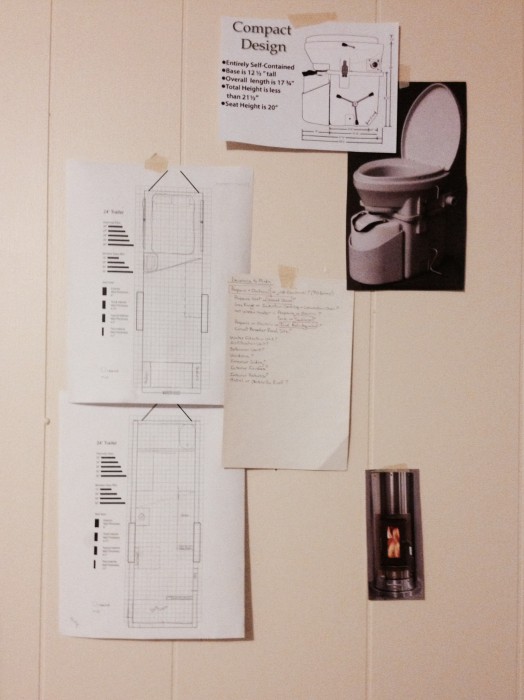
photoWe are the only people I know who have a picture of a toilet on their wall.  Then again, we are the only people I know who are building a tiny house — which means we should probably go out and meet more people. But that toilet represents an important victory.

As we’re coming to learn, building this tiny house is a series of decisions upon decisions.  Sure, you have to pick out the floor color and the stove and the refrigerator.  You also have to pick out how the refrigerator runs: propane or electricity?  If you want electricity, do you go with AC or DC?  Or both? How are you going to supply electricity, with a solar array or an RV hookup?  Or both?  What size RV hookup? What size solar array?  What make/model of panels?  How are you going to arrange them?  What batteries do you need?  What kind of inverter?  What kind of circuit breaker panel?  Ok.  Let’s move onto the stovetop.  Propane, electric, or induction?  How many burners?  Drop in or stand-alone?  Can your chosen circuit breaker panel handle it?  Can your solar array?  Do you need to get different pans for induction? Do you have enough counter space?  Over and over and over again.

Seth and I have been together for more than a decade. As in every relationship, we’re constantly renegotiating how we handle things, from prescription pickup to transportation to taxes.  It changes depending on where we are and what we’re doing.  And what we’re doing now is realizing our decision-making process isn’t great.  Enter: the wall.

The wall is our free-form, nebulous method of marking down choices as well as keeping each other motivated.  It’s next to our kitchen table so we can see it every day.  It’s not beautiful — not as beautiful as the vintage Chicago travel poster we used to have in its place (sorry Elise) — but it’s important so we can see how far we’ve come.  We have a toilet.  We have a heater.  We have a trailer, and we have a list.

There will soon be a notebook that we share back and forth, in which we’ll write down what we’ve learned about whatever it is we’re researching.  And all along the way, we’re dividing the build into smaller, manageable chunks so that we don’t get overwhelmed.  We’re setting a schedule.  We’re setting Craigslist alerts.  We have a system.

I’m finding that short, declarative sentences really help keep me stable.

Dog problems

Posted on November 23, 2014

photo

Now that the farm season is winding down, we have a problem. A dog problem. As in a dog who doesn’t spend eight hours a day outside anymore, and who now thinks we are terribly frustrating humans.  It’s not so bad on the weekends when we take our walks, but even then a 1.5-2 hour walk isn’t enough to keep this dog in high spirits.

Seth and I knew this would be a problem, but I guess I didn’t realize how much until last weekend’s fall party when no less than four people said, “Is that Lily?  Lily!  I didn’t recognize you inside the house!  You look so different.  Your ears are back and you’re not sniffing everything.”

She really, really doesn’t want the winter off.

photo(2)

We can go for walks at night after work, but it’s not really her jam.  It’s as if she thinks that since we can’t go for 2+ hours, then we shouldn’t go at all.  We get a few streets away and then she stops mid-stride and turns back for home.  Well, maybe that’ll change once winter really sets in.  Who knows?  We might even get lucky and get a blizzard to dump 50″ of snow, which will give the dog some resistance as she prances (and I cry).

photo(1)

We are so screwed.